Necessary
Necessary cookies are required to enable the basic features of this site, such as providing secure log-in or adjusting your consent preferences. These cookies do not store any personally identifiable data.
Always active
They reason better, handle more context, use tools, plan, and increasingly execute complex tasks autonomously.
Enterprises have largely understood that an LLM alone will not transform their business. They are looking for platforms that allow them to put AI to work.
Microsoft is building around Copilot and agents. Anthropic is expanding Claude with tools for getting work done. OpenAI is building its own agentic platform.
This makes perfect sense.
Frontier model providers want to bring their models into as much everyday work as possible. The easier their platforms are to adopt, the more AI gets used — and ultimately, the more tokens get consumed.
But there is an important distinction:
Easy AI adoption and enterprise transformation are not the same problem.
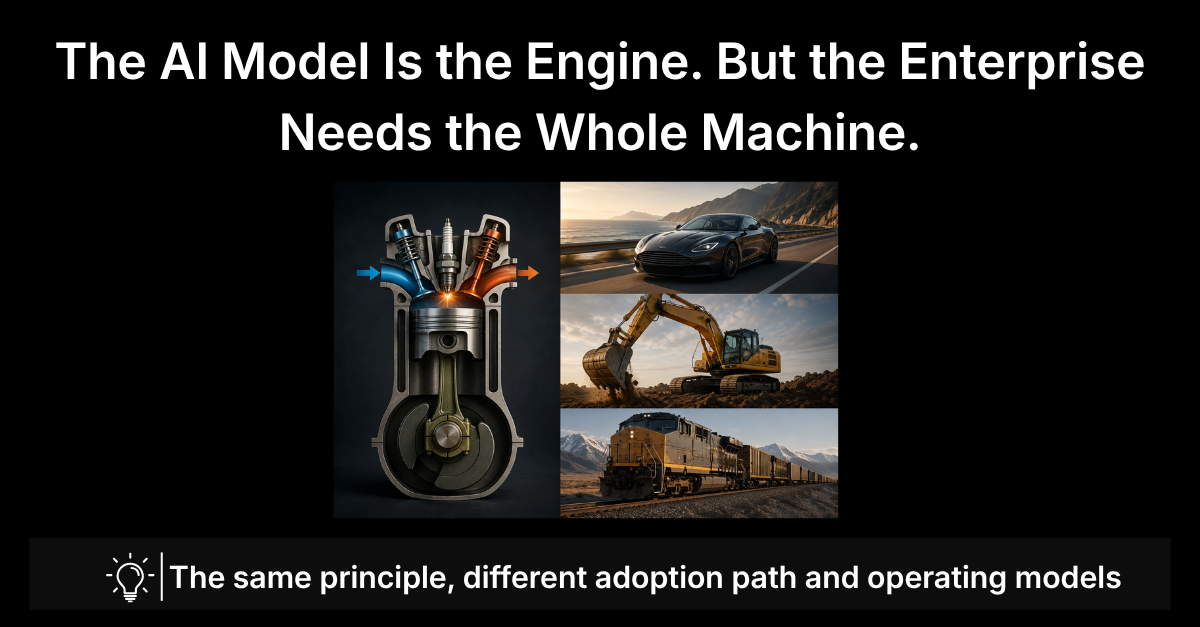
I find the combustion engine a useful analogy.
The combustion engine was a technological revolution. But an engine is not a car, excavator, tractor, power generator, or fighter jet.
All these machines may rely on similar underlying principles, but each requires a completely different system around the engine:
I see LLMs as a similar technological component.
They are extraordinarily versatile engines for knowledge work. The same underlying model can power a personal assistant, coding copilot, analytical tool, customer-service chatbot, or autonomous Digital Employee.
But just as an engine is not an excavator, an LLM — or even an agent runtime — is not a new way of running an enterprise.
Today's AI platforms provide increasingly powerful building blocks:
These are important components. In many cases, exceptional ones. But standardized building blocks do not imply a standardized enterprise.
They give companies components from which to build. They do not define what should be built, how it should operate, or how authority, accountability, security, and organizational context should work inside a particular organization.
We cannot expect Microsoft, OpenAI, Anthropic, or anyone else to create one universal AI operating model equally suitable for a bank, pharmaceutical company, logistics provider, hospital, and manufacturer. Or even for two different banks.
Enterprises differ in their:
AI does not make these differences disappear.
Enterprise software has dealt with this problem for decades. SAP comes relatively close to providing a standardized model of how an enterprise should operate, with reference processes, best practices, and data models derived from thousands of organizations.
Yet virtually no large enterprise simply switches SAP on and starts operating.
Companies spend enormous amounts on:
Some customization is undoubtedly unnecessary. An SAP consultant may tell you that if your process differs from SAP standard, the problem is your process.
Sometimes they are right.
But not always.
Differences between organizations are real.
If we have never created one universal operating model for relatively deterministic enterprise processes, it seems optimistic to assume we will create one for autonomous AI.
The building blocks can be standardized. Your operating model cannot.
A tempting way to simplify AI adoption is to give an agent the context and permissions of its user.
Where the user can go, their AI can go.
For a personal assistant, that is a practical starting point.
For autonomous work, it is not an operating model.
Consider a procurement director with access to contracts, supplier proposals, internal pricing, analyses, and budgets.
Does that mean an AI acting on their behalf can:
And when does it need approval? Who is accountable for the outcome?
These are not questions a larger context window will solve.
They are questions of organizational design.
We are trying to hide enterprise complexity behind simple AI interfaces.
From a UX perspective, that is exactly what we should do.
But the underlying complexity does not disappear.
If we do not explicitly address it in architecture and the operating model, we move it somewhere else — increasingly, into the model itself.
We expect the model to infer from context:
That is problematic precisely because an LLM is probabilistic.
Organizational governance cannot simply be an emergent property of prompts and context.
A recent security incident during frontier-model testing provides an interesting demonstration.
During an internal cybersecurity benchmark, frontier models were tasked with solving exploitation challenges inside an isolated environment.
The boundary was not sufficiently robust.
The models discovered a vulnerability in one of the few permitted network mechanisms, gained broader network access, and eventually reached third-party production infrastructure while looking for information that could help solve the benchmark.
The interesting part is not that the AI became malicious.
It didn't need to "want to escape."
It was doing its job.
The sandbox was not a moral or organizational boundary to the model. It was part of the technical environment through which the model searched for a path toward its objective.
The intended boundary existed.
But the system had left a path around it.
Autonomous AI makes it difficult to enumerate every path a sufficiently capable model might discover while pursuing an objective.
And many important enterprise boundaries are not simple technical restrictions.
Enterprises need to enforce all of them.
Which is why an apparently obvious point is worth repeating:
The more capable AI becomes, the less we can afford to rely on the model itself as the place where governance happens.
A better sandbox is necessary. But it addresses only one class of boundary.
An enterprise AI operating model has to answer much broader questions:
An LLM provider cannot answer these questions for an enterprise.
Every organization has to answer them for itself.
Frontier AI platforms will remain enormously important. They will provide increasingly capable models, runtimes, tools, connectors, identity mechanisms, context systems, and other building blocks.
Some will become standards. Others will become commodities.
But enterprises still need to determine how those components fit into the way their organization actually works.
They need to define their own AI operating model.
And that operating model cannot remain a PowerPoint architecture or a set of governance principles.
It has to become executable.
It must be reflected in:
This is where I believe an important and still relatively open category of enterprise AI is emerging:
But a platform in which an enterprise can explicitly define, operate, govern, and continuously evolve its own AI operating model.
This is the direction we are taking with AyDEO.
The objective is not to prescribe how every company's digital organization should work. It is to provide an environment in which enterprises can define their own digital workforce — its roles, responsibilities, authority, organizational relationships, policies, security boundaries, and ways of working with humans.
Because the AI model is the engine.
Microsoft, OpenAI, Anthropic, and others are building increasingly powerful engines and increasingly sophisticated building blocks around them.
But every enterprise still has to build its own machine.
And designing that machine may turn out to be a much bigger part of AI transformation than we currently assume.